Les Cahiers du Digital : Call for contributions
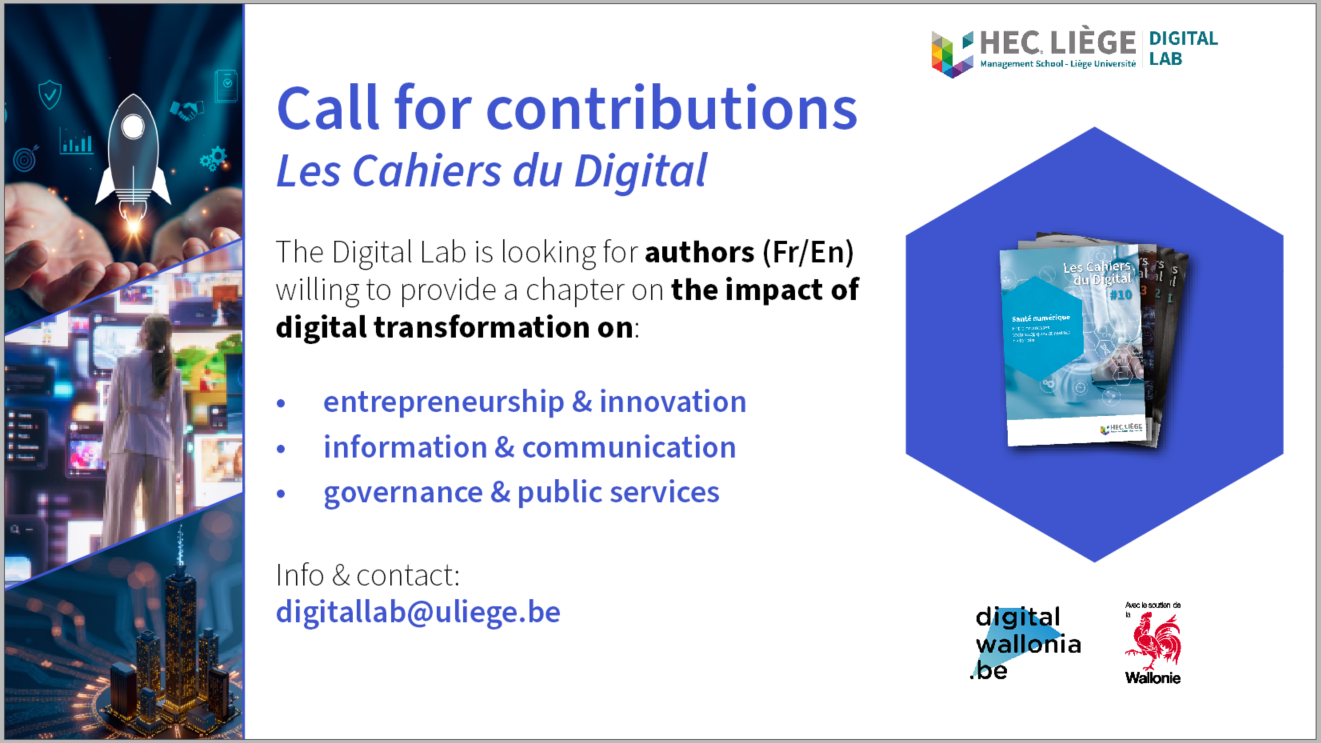
For future issues of Cahiers du Digital, the Digital Lab is looking for authors to write articles on one of the following three topics. We invite researchers, practitioners, experts, and field workers to share their analyses, case studies, and critical reflections.
Information, communication, and reputation in the age of social media
At a time when information circulates at high speed and is reconfigured in changing digital environments, organizations, media, and individuals face new challenges: the proliferation of communication channels, online public relations management, reputational risks, the circulation of fake news, visibility and influence strategies, etc. We invite you to explore these contemporary changes in information and communication.
Suggested topics to choose from (non-exhaustive list):
- Communication and public relations management in a digital context;
- Digital reputation and brand image dynamics;
- Response strategies to media crises;
- Disinformation and its impact on governance and organizational trust;
- Information monitoring and economic intelligence in a digital environment;
- New media models: between journalism and brand communication;
- Data, algorithms, and content visibility;
- Ethical and regulatory issues related to digital communication and information;
- Sectoral or international comparisons: case studies in different professional environments;
- …[Other topic of your choice]
Entrepreneurship and innovation in the age of digital tools
Digital technology is profoundly transforming entrepreneurial dynamics and innovation processes. New collaborative tools, crowdfunding platforms, generative artificial intelligence, immersive environments, and digital innovation ecosystems are redefining the way projects are designed, launched, and developed. These developments affect start-ups as well as large companies, public organizations, and associations.
Suggested topics to choose from (non-exhaustive list):
- Digital platforms and ecosystems for entrepreneurship
- Automation and idea/prototype generation
- Collaborative tools and distributed work in value creation
- Digital financing: crowdfunding and new investment methods
- Open innovation and online communities as project accelerators
- Digital strategies for start-ups: visibility, acquisition, and scalability
- Digital transformation of intrapreneurship in companies
- Ethical, organizational, and managerial issues related to the use of technology in entrepreneurial endeavors
- …[Other topic of your choice]
The connected state: e-government and the digital society
Digital technology is profoundly transforming the way public institutions design, implement, and evaluate their actions. Paperless administrative procedures, participatory platforms, open data, artificial intelligence, cybersecurity, algorithmic transparency, and data governance are all changes that are redefining the relationship between the state, local authorities, and citizens.
These transformations are not just a matter of technological modernization: they challenge the very foundations of public action, citizen participation, digital sovereignty, and the new balance between efficiency, inclusion, and trust.
We invite you to explore the challenges, practices, and prospects of digital governance. Researchers, digital experts, public officials, decision-makers, consultants, and civil society actors are invited to share their analyses, experiences, and reflections.
Suggested topics to choose from (non-exhaustive list):
- Digital transformation of public administrations and services
- Data governance, interoperability, and digital sovereignty
- Citizen participation platforms and digital democracy
- Artificial intelligence and public decision-making
- Public policy in the age of algorithms: transparency, bias, and regulation
- Cybersecurity, resilience, and continuity of public service
- Digital inclusion and equitable access to online services
- Smart cities and connected territorial governance
- Interinstitutional cooperation and public digital innovation
- Ethics, trust, and responsibility in digital governance
- … [Other topic of your choice]
Modalities
Contributions—which must be between 3,000 and 5,000 words in length—may be submitted in French or English. They will be evaluated through a process of scientific and professional review prior to publication. They may be based on academic research, case studies, feedback, or comparative analyses, and may concern both the business world and other organizations.